Slope vs Elbow: The Two FRP Rooftop Fan Shapes
Two shapes, one material
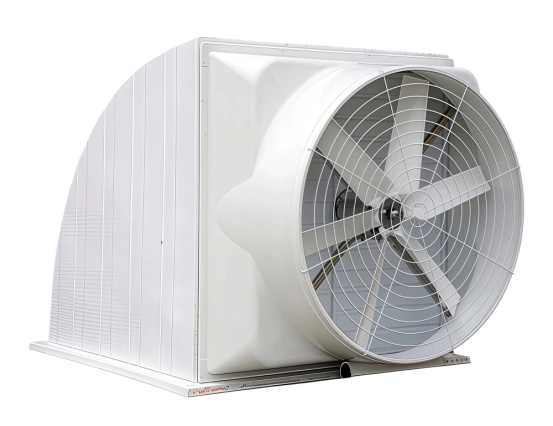
The manufacturer's FRP rooftop range comes in two shapes that look similar from the ground and differ in every detail that matters on the roof. The slope type carries a waterproof dome-shaped cap on a sloping housing, with a wind deflector and a 1.9-metre awning against rain. The elbow type carries a bent, elbow-shaped housing with PVC shutters at its outlet. Both are glass-fibre-reinforced plastic, both use six blades as standard, both run on 380 or 220 volts at 50 hertz, and both move air in the same band — 28,000 to 45,000 cubic metres per hour. A buyer who compares them on airflow alone will find almost nothing to choose between. The choice lives in the shape, the shutters, the noise figures, and the roof the fan sits on, and those are the subjects of this article.
The slope shape: cap, deflector, awning
The slope page describes a roof-mounted industrial exhaust fan with a waterproof dome-shaped cap, a wind deflector, six axial blades and a modular design. The cap is the point of the shape: it sheds rain and deflects wind away from the fan opening, and the 1.9-metre awning extends that protection further against rain. The housing is a hand-laid glass-fibre-reinforced plastic shell with a secondary-treated smooth surface, and the drive is direct. For a roof that takes driving rain, or a site where the fan opening must stay protected in bad weather, the cap and the awning are the slope family's real argument — not a styling choice but a weather-protection one. The slope family's modular design is stated on the page without further detail, so this article claims nothing more for it than the page does: modularity is named, not specified.
The elbow shape: shutters and a simple structure
The elbow page describes a fibreglass exhaust fan for medium and large factories that creates a negative-pressure indoor environment while introducing fresh air, and calls it lightweight, easy to install and low in energy consumption, with a smooth-surfaced FRP housing that is UV and weather resistant for indoor and outdoor use. Its distinguishing feature is at the outlet: PVC shutters against flies and backflow. Shutters matter in two situations the slope cap does not address. Flies and insects enter through an unshuttered outlet, which matters in farm and food buildings. And backflow — stale air pushed back into the building when the fan stops — is stopped by a shutter in a way a cap alone does not achieve. The elbow structure is described as simple, with a direct-connected motor, which is a maintenance point as much as a construction one: fewer parts between the motor and the blades means fewer parts to service on a roof.
The tables, side by side
The slope table lists two models. DH-WD1460 has a 1250 mm propeller, 49 inches, runs at 560 rpm, moves 45,000 cubic metres per hour, and is rated at 1.1 kilowatts, with overall dimensions of 1460 by 1460 by 960 mm and a roof hole of 1400 by 1400 mm. DH-WD1060 has a 890 mm propeller, 36 inches, runs at the same 560 rpm, moves 28,000 cubic metres per hour, and is rated at 0.75 kilowatts, with dimensions of 1060 by 1060 by 930 mm and a hole of 1000 by 1000 mm. The elbow table lists four models. DH-1460EL moves 45,000 cubic metres per hour at 540 rpm with a 1240 mm propeller and a noise figure of 65 dB. DH-1260EL moves 38,000 at 540 rpm with a 1070 mm propeller and 60 dB. DH-1060EL moves 30,000 at 540 rpm with a 880 mm propeller and 60 dB. DH-850EL moves 28,000 at 680 rpm with a 650 mm propeller and 55 dB. The elbow range therefore offers two middle sizes the slope range does not, and the slope range offers a hole size the elbow table does not publish — both facts a buyer matching an existing opening needs to know.
Blades, and the option lists
Both families use six blades as standard, but their blade stories differ. The slope family uses SMC glass-fibre blades in a six-blade assembly, with 7 nylon blades and 3 cast aluminium blades listed as options — an option list that changes the blade count and material, not just the material. The elbow family uses an SMC fibreglass frame and blades, with blade materials customizable to cast aluminium, nylon or stainless steel — a material choice at a fixed six-blade count. Neither page states which blade option suits which air, and this article does not guess: a buyer in corrosive, dusty or humid air should state the air and ask which blade material the supplier recommends for it, rather than picking from the option list on price. What the option lists do establish is that both families can be configured beyond their standard blades, and that the configuration should be confirmed model by model in the inquiry.
Noise: only one family publishes it
The elbow table is the only table on the four source pages with a noise column, and its figures — 65, 60, 60 and 55 dB from the largest to the smallest model — are the only verified noise figures on this site. The slope page publishes no noise figure. That asymmetry should shape the choice wherever noise matters: near housing, near offices, or inside a building where the fan is audible. A buyer with a noise limit has verified figures for the elbow family and none for the slope family, and the honest response to that gap is to ask for the slope figure, not to assume the slope family is quieter or louder than the elbow range. Noise also tracks size within the elbow range — the smallest model is the quietest by 10 dB — which is a useful reminder that the right size is often the quieter size, and that oversizing a fan buys noise as well as airflow.
Applications: overlap with differences
The application lists overlap heavily, and the differences are in the details. Both pages list textile, garment, glass, molding, rubber, coating, toy, electronics, shoe or footwear, printing, food, dyeing and laundry workshops. Both list large farms, greenhouses and livestock or poultry buildings. The slope page adds civil spaces — net bars, stores, supermarkets, halls, food markets, waiting rooms and recreation places — while the elbow page adds commercial and public spaces — internet cafes, retail stores, supermarkets, exhibition halls, food markets, waiting areas and recreational spaces. The two lists are nearly the same buildings in different words, which tells the buyer something useful: the manufacturer does not position these families for different building types. It positions them for different roofs, different weather, and different outlet needs, and the application lists confirm that the choice is about the installation, not the industry.
How to choose between them
Four questions settle it. First, the roof opening: the slope table gives hole sizes, the elbow table does not, so an existing opening may decide the question before anything else. Second, the weather: driving rain favours the slope cap and awning, while flies and backflow favour the elbow shutters. Third, noise: the elbow family has published figures, the slope family does not, so a noise limit points to the elbow range or to a question. Fourth, size: the elbow range offers four models against the slope range's two, so a middle airflow need may fit an elbow model exactly where a slope model would overshoot or undershoot. Voltage is not a decider — both families run on 380 or 220 volts at 50 hertz — and neither is airflow at the top end, where both families reach 45,000 cubic metres per hour. Work the four questions in order, with the roof described, and the shape chooses itself.
Facts used here come from the manufacturer's own product pages for the slope-type and elbow-type FRP rooftop fans. No noise, coverage, temperature or cost figure appears here that those pages do not state — those numbers depend on the installation and the building, and they belong in a project inquiry, not a general article.
Request a rooftop fan layout
Send your building type, roof opening, and voltage, and ask for a layout using the fan families on this page. Before payment, confirm MOQ, lead time, voltage, and warranty for your order.