Axial DWT-I rooftop fan
The carbon-steel DWT-I tables behind the explosion-proof statement.
Rooftop exhaust fans from Foshan, China — FRP slope and elbow fans, carbon-steel and FRP axial DWT-I roof fans, for factories, warehouses, farms and commercial buildings.
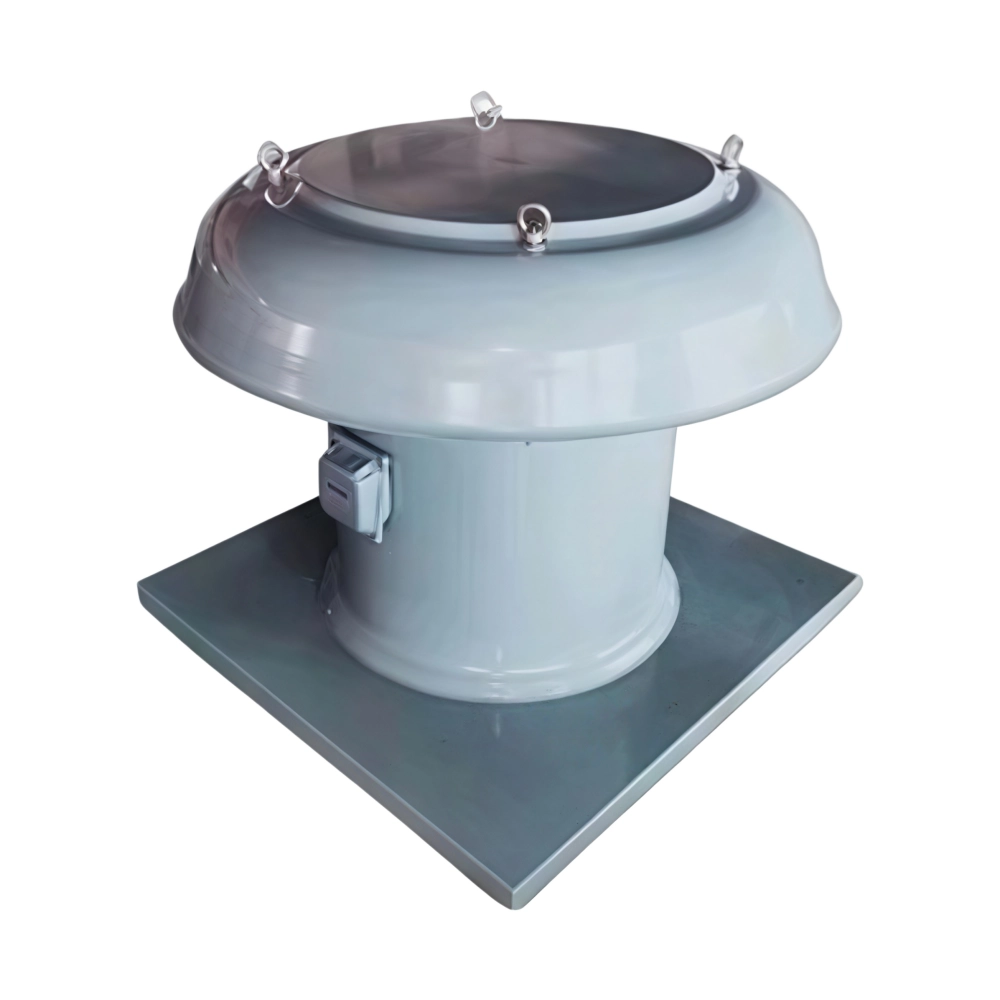
An explosion-proof version is mentioned on exactly one source page: the carbon-steel DWT-I page states that an explosion-proof version is available for flammable, explosive and corrosive-gas environments. This page sets out what that statement does and does not establish, and what a buyer must confirm before ordering anything under that name.
The carbon-steel DWT-I page states, as a page-level claim, that an explosion-proof version is available for flammable, explosive and corrosive-gas environments. That is the whole of the published evidence. No source page publishes an explosion-proof model number, an explosion-proof specification table, a certification name, a certification number, a gas group, a temperature class, or a construction standard for any explosion-proof version. No source page publishes a separate photograph of an explosion-proof version. The photograph on this page shows the standard carbon-steel DWT-I family, captioned as a product image from the manufacturer's site, and it must not be read as a photograph of an explosion-proof unit. Any page that presented an explosion-proof model with specifications would be inventing them, and this site does not do that.
Explosion-proof, as a buyer requirement, is a property of the whole fan in its installed environment: the motor, the electrics, the impeller and the housing must all suit the gas, the zone, and the rules that apply at the site. That is why the requirement cannot be satisfied by a single catalogue sentence. The gas matters — what it is, how much of it is present, and whether it is flammable, explosive, corrosive, or more than one of those at once. The place matters — whether the fan sits in a classified zone, and which classification the site's rules assign to it. And the paperwork matters — which certification the site's inspector will accept, and whether the unit supplied carries it. None of those three is answered by the source pages, so all three must be answered in the inquiry, with the site's requirements stated, before any explosion-proof version is ordered.
The explosion-proof statement stands on the carbon-steel DWT-I page, so the natural starting point for the underlying fan is the carbon-steel DWT-I range: eleven tabled models from DWT-I-3A to DWT-I-11.2A, with powers from 0.18 kW to 7.5 kW and tabled airflows from 1,900 m³/h to 53,855 m³/h across their operating points. Those are the standard range's figures, not explosion-proof figures, and they are reproduced in full on the axial page. A buyer should expect the explosion-proof version to differ in construction and possibly in performance, and should ask for its own table rather than reading the standard table as the explosion-proof specification. The FRP DWT-I page carries no explosion-proof statement at all, so an explosion-proof FRP variant must not be assumed either; if one is needed, it must be asked for explicitly and confirmed the same way.
Search terms for explosion-proof fans often name paint booths and spray booths, and those are real use cases where flammable vapours make protected equipment a genuine requirement. The source pages do not name paint booths or spray booths, and this site does not claim any model is suited to them. A paint-booth or spray-booth buyer has the strictest version of the questions above: the vapour, the zone, the certification, and the unit's own table, all in writing, before ordering. A general statement that an explosion-proof version exists is not an answer to any of them.
Before ordering, confirm: the exact model and voltage for your site, the airflow and size you need, MOQ, lead time, and warranty. This page lists only what the source material verifies; anything not listed here is a question to ask, not a specification to assume.
The carbon-steel DWT-I tables behind the explosion-proof statement.
The FRP variant, which carries no explosion-proof statement.
Industrial applications from all four source pages.
Send your building type, roof opening, and voltage, and ask for a layout using the fan families on this page. Before payment, confirm MOQ, lead time, voltage, and warranty for your order.