Downblast roof exhaust fan
The downward-discharge counterpart, with the same evidence position.
Rooftop exhaust fans from Foshan, China — FRP slope and elbow fans, carbon-steel and FRP axial DWT-I roof fans, for factories, warehouses, farms and commercial buildings.
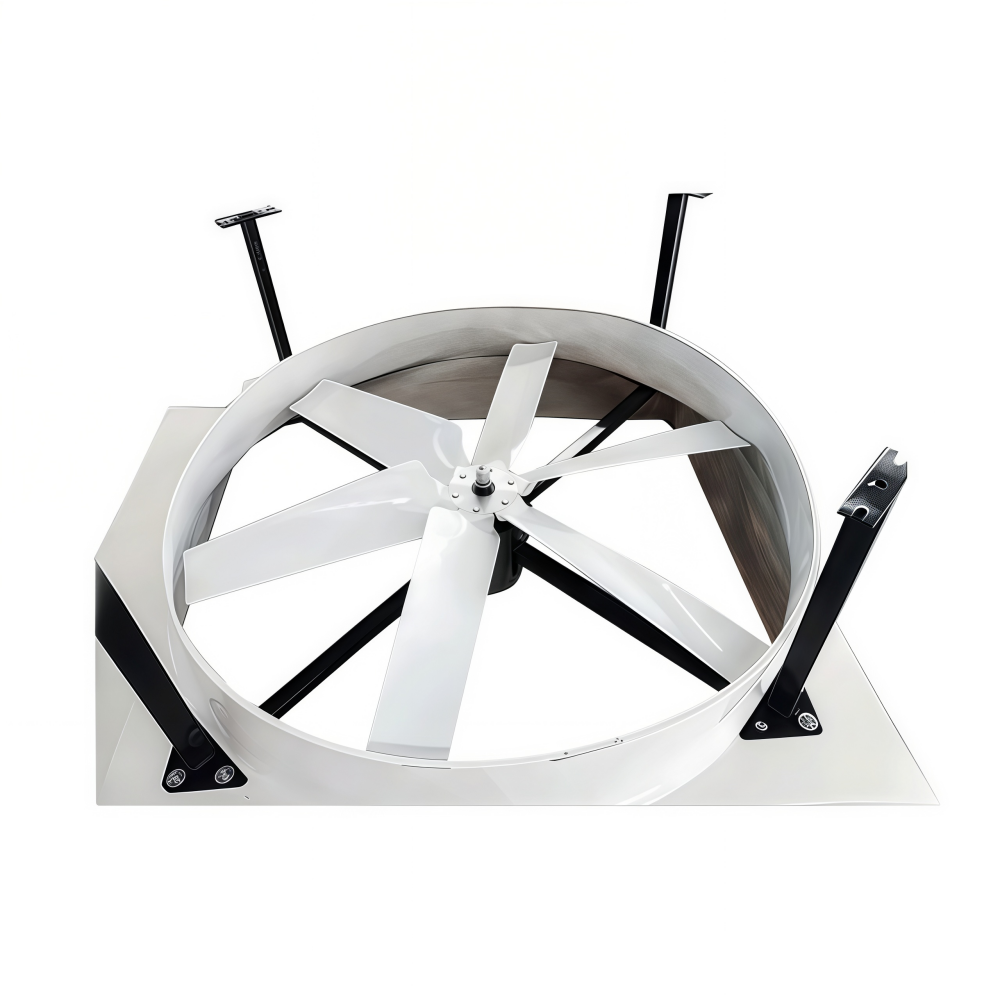
Upblast describes a discharge direction, not a model. An upblast roof exhaust fan discharges its air upward, away from the roof surface. This page explains what that means, what the manufacturer’s pages do and do not list under that name, and what to confirm when upward discharge is what a building needs.
In an upblast arrangement, the fan throws its exhaust air upward, so the discharged air leaves the roof zone instead of washing back across the roof surface or into nearby openings. The name says nothing about the fan's size, airflow, power, or housing material: those come from the specification table of the model being considered, and an upblast requirement on its own does not select a model. Buyers sometimes use upblast, upblast ventilator and upblast fan interchangeably in search terms, but on a specification sheet only the discharge arrangement and the tabled figures matter. If a supplier quotes an upblast fan, the discharge arrangement should be confirmed in the same writing as the airflow and the dimensions, because the word alone does not guarantee any of them.
No source page on the manufacturer's site labels any model upblast, and no source page publishes an upblast-specific specification table. The four rooftop families — slope FRP, elbow FRP, carbon-steel DWT-I and FRP DWT-I — are described by their housing shape and material, not by a discharge-direction label. That absence matters: this site does not relabel any of those families as upblast fans, and it does not present the photograph on this page as an upblast unit. The photograph shows a slope-type FRP fan impeller, captioned as a product image from the manufacturer's site, and the page text states plainly that no upblast-specific model is listed. A buyer who needs upward discharge should ask the supplier to confirm, for the exact model quoted, how the air is discharged and whether the discharge arrangement matches the roof layout.
Upward discharge is usually specified where discharged air must clear the roof zone: where nearby intakes, windows or neighbouring roofs sit close to the fan, where discharged air washing across the roof would re-enter the building, or where the roof carries equipment that discharged air must not reach. Those are layout reasons, and they are decided by walking the roof, not by reading a catalogue. The relevant checks are the position of intakes relative to the fan, the height of the discharge above the roof, and the distance to the nearest opening that could take discharged air back in. None of those checks appears as a figure on any source page, so all of them belong in the inquiry, with the roof layout described, rather than in an assumption drawn from the word upblast.
The families whose tables a buyer compares after settling the discharge question are the FRP slope and elbow families and the two DWT-I axial variants. The slope family carries a waterproof dome-shaped cap with a wind deflector; the elbow family carries PVC shutters against flies and backflow; the DWT-I families carry an anti-corrosion wind cap. Whether any of those arrangements delivers the upward discharge a particular roof needs is a question for the supplier, answered model by model — not a label this site assigns.
Before ordering, confirm: the exact model and voltage for your site, the airflow and size you need, MOQ, lead time, and warranty. This page lists only what the source material verifies; anything not listed here is a question to ask, not a specification to assume.
The downward-discharge counterpart, with the same evidence position.
Slope, elbow and FRP DWT-I families with their own tables.
The selection sequence: application, airflow, voltage, discharge, material.
Send your building type, roof opening, and voltage, and ask for a layout using the fan families on this page. Before payment, confirm MOQ, lead time, voltage, and warranty for your order.