Axial DWT-I rooftop fan
Carbon-steel DWT-I tables, including the five-column dimension table.
Rooftop exhaust fans from Foshan, China — FRP slope and elbow fans, carbon-steel and FRP axial DWT-I roof fans, for factories, warehouses, farms and commercial buildings.
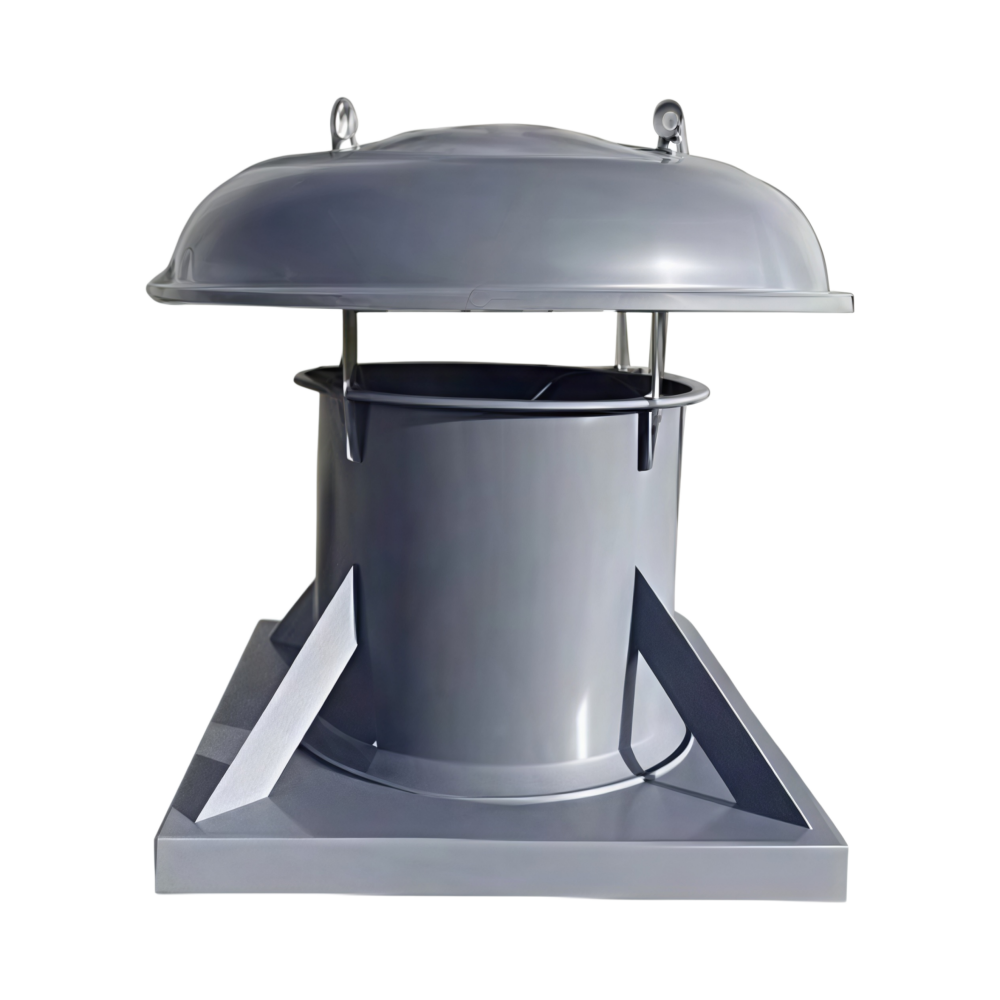
Every fan on this site is roof-mounted: the slope and elbow families sit on the roof with a waterproof cap or an elbow housing, and the DWT-I axial families sit on the roof as flat or curb-mounted units. This page gathers the mounting facts the source pages actually publish — hole sizes, overall dimensions, and the two different DWT-I dimension schemes — so a buyer can match a fan to an existing roof opening.
The slope table is the only one that lists a roof hole size. DH-WD1460 takes a 1400 by 1400 mm hole, and DH-WD1060 takes a 1000 by 1000 mm hole, against overall dimensions of 1460 by 1460 by 960 mm and 1060 by 1060 by 930 mm. The elbow table lists overall dimensions — height, width and thickness — from 850 by 850 by 480 mm to 1460 by 1460 by 580 mm, but no hole size, so an elbow buyer must confirm the opening with the supplier rather than reading it from the table. The DWT-I pages list overall dimensions in two different schemes: five columns (A, B, C, D, H) on the carbon-steel page and seven columns (diameter A, diameter B, C, D, E, F, H) on the FRP page. The two schemes are not interchangeable, and this site never carries a dimension from one scheme onto the other page.
On the carbon-steel page, the H column runs from 230 mm on DWT-I-3A to 850 mm on DWT-I-11.2A, and the A and B columns run from 480 mm to 1420 mm. On the FRP page, the H column reads 68 mm on every row, and the diameter A column runs from 667 mm to 1760 mm. The FRP H figures are recorded as printed and are not reinterpreted as a fan height: the FRP page uses a different dimension scheme, and its H column reads as a flange or base thickness in that scheme. A buyer comparing the two DWT-I variants must therefore compare each variant against its own dimension table, on its own page — the axial page for carbon steel, the FRP page for FRP — and must not mix columns between them. The dimension diagrams published on the carbon-steel page are installation figures, not product photographs, and are captioned as diagrams where they appear.
The slope family carries a waterproof dome-shaped cap with a wind deflector and a 1.9-metre awning against rain, which is the slope page's own description of its weather protection. The elbow family carries PVC shutters against flies and backflow, and a smooth-surfaced FRP housing described as UV and weather resistant. The DWT-I families carry an anti-corrosion wind cap, with a metal or glass-fibre-reinforced plastic wind-cylinder base, and the FRP variant adds a fibreglass roof cap described as corrosion and UV resistant plus a safety net. Those are the weather-protection facts the source pages state. No source page states a wind-load rating, a snow-load rating, or a waterproofing grade, so none is claimed here; a buyer in a high-wind or heavy-snow location should ask for the applicable rating in writing.
The slope family uses a direct-drive design with six axial blades in an SMC glass-fibre assembly, with 7 nylon blades and 3 cast aluminium blades listed as options. The elbow family uses a direct-connected motor with an SMC fibreglass frame and blades, and blade materials customizable to cast aluminium, nylon or stainless steel. The DWT-I families use a molded axial-flow or centrifugal impeller with a fan-specific motor in direct drive. Direct drive matters on a roof because it removes belts from the maintenance list, but the source pages state the drive arrangement only, and this site adds no maintenance-interval or bearing claim beyond what those pages say.
Before ordering, confirm: the exact model and voltage for your site, the airflow and size you need, MOQ, lead time, and warranty. This page lists only what the source material verifies; anything not listed here is a question to ask, not a specification to assume.
Carbon-steel DWT-I tables, including the five-column dimension table.
Slope, elbow and FRP DWT-I tables, including the seven-column dimension table.
The selection sequence: application, airflow, voltage, discharge, material.
Send your building type, roof opening, and voltage, and ask for a layout using the fan families on this page. Before payment, confirm MOQ, lead time, voltage, and warranty for your order.